
“The Old Man, the Old Flag and the Old Policy”
That was the slogan that won John A. Macdonald the election in 1891 at the ripe age of 76 and then, exhausted by his long campaign fought on the old standbys of protective tariffs, nationalist appeals and British ties, he died on June 6 1891.
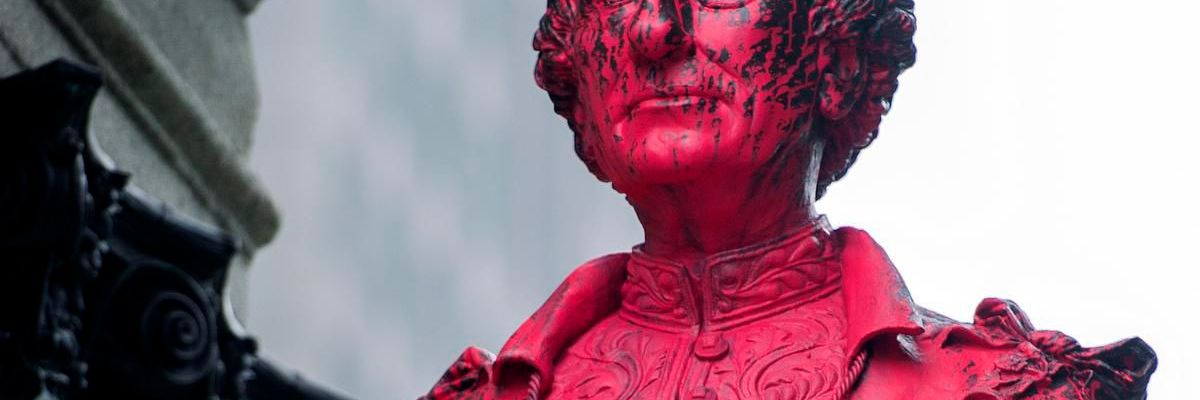
If anything good has come out of the recent dismantling of John A. Macdonald’s statue in Victoria recently, it’s that it has forced me to search deeper into the foundational roots of our Country and place our Father of Confederation under my objective scrutiny. Understand that I am not a Canadian citizen YET, and cannot vote governments in or out of power, I can only sit back and idly watch as events like these materialize with an alarming frequency. We appear bent on not examining our often imperfect past, but erasing it, and that is a dangerous place to be for any fledgling – and we are still fledgling -society which still does not understand what type of role it plays on the world stage, but instead continues to chastise itself for it’s past wrongs.
I see nothing wrong with taking ownership of certain events in our past where we might have lost our way, but lets do exactly that; own it, correct it and then never forget it, but at the same time can we not focus on the good and celebrate the greatness that we have become?
I tell my kids all the time: “Okay, what you did was wrong, like, really wrong, do you agree? Yes. Okay, do you sincerely apologize to all those who were affected by your actions? Yes. Great, okay so lets not forget the lessons we’ve learned from this, but, lets not harp on it any longer. Instead, here are some of the really cool things you’ve done lately, lets celebrate those shall we?!” And with that approach, we lean further forward into the future without guilt, but with a cautious hand on our imperfect past. The thing about guilt is that it can cripple your ability to move beyond the past and toward a better future. I know that for a fact.
On September 1, 1864, a delegation of Canadians descended upon PEI led by a young Kingston attorney named John A Macdonald and an equally canny Montreal based lawyer named George-Etienne Cartier along with reformer George Brown. The conference, known as the Charlottetown Conference, in many ways became an unabashed schmooze-fest complete with flowing wine, elegant balls, expensive dinners and plenty of Canadian charm but the end result of the proposal was what mattered the most. The Maritimers, initially lukewarm, were won over and the outline of the new Federation was born.
In October, delegates met again in Quebec where the 72 resolutions crafted by John A Macdonald were laid out and this is where, more then any other person, John A. can claim to be the “author” of modern Canada. Initially it was proposed that we form a “Unitary state” like France or England with their strong central governments, however that was quickly shot down as a country as large and regionally diverse as Canada could not sustain this type of model.
Instead, a federal system was agreed upon, the new country would have two levels of government with one central system to manage matters of common national interest and provincial ones to manage local and regional matters.
The story continues: Canada’s first federal election and John A’s first working majority in 1867, Louis Riel and the Red River Resistance, the full scale transcontinental railway which was started within 2 years and completed in 10, ultimately bringing BC into confederation. The British North America act and yes, treaties which the Canadian government interpreted as the permanent end to native lands claims. To the government they were “writs of sale”. To the native leaders, they were pacts between peoples.
The Pacific Scandal and the controversial awarding of rail contracts, the fall and resurrection of John A Macdonald as he is swept back into power on promises of increased immigration, an anti-american protective tariff strategy that did strengthen the economy and then their was, in the end, the execution of Louis Riel.
The Residential Schools, which attempted to assimilate indigenous children into Euro-Canadian culture was a dark time indeed and I don’t have to read far to understand how awful this system was, and regretfully, even as a permanent resident I feel shame for this historical mess which was the root of many issues we see today in our relations with the indiginous people of this country. It is debatable that John A was the original architect of the residential school system, and even if he was, ultimately, it appears this is the one component of his legacy that we, or some, have chosen to focus on.
I don’t believe there is one single individual on this earth who doesn’t have deep regrets regarding an episode or choice they have made in their lives, and I am sure if Sir John A Macdonald were alive today, he would judge himself not on the great causes he has championed for our beautiful nation, but on the shameful choices he made as he exploited the powers given him during his term as our Prime Minister.
But, apparently, we can’t leave it alone and instead of accepting the imperfections of our heritage as being a part of our natural growth process, we place them under our microscopes and judge them and criticize them and shame them because it makes us feel better about our own short falls. For every two things I have done right, I have done just as many wrong, but I didn’t draft out the foundation of our Nation, so it makes me just…. human.
But for an important figure like John A Macdonald, the man whom had the courage to begin constructing the very fabric of the most free and accepting country in the world, the land we call home and the land that allows us the freedom to openly criticize, we treat him like he is a villain, a subject to be sentenced to public shame.
Did you also know that John A Macdonald attempted to extend the right to vote to both women and Native Canadians during his time in office, but it was rejected? Probably not, because his recent narrative tells us of a person who fell shy of such great initiatives.
So what is next for us?
What is the next target? Will it be the World War memorials because they represent a violent section in our historical timeline? Will it be Prime Minster Robert Borden and the conscription crisis of 1917? Perhaps we will bury the fact that during the years of the holocaust Canada shamelessly accepted less jewish refugees then Great Britain, The United states, Argentina or Brazil with only 5000. Mackenzie King wanted to keep this part of the continent free from unrest and too great an intermixture of foreign strains of blood. Especially Jewish blood.
And then there is the whole Asian Immigrant episode which saw some of the worst discrimination Canada has ever been involved with. But that story is for another day….
Last year Lisa Helps, the mayor of Victoria, decided to form a group to address issues of reconciliation toward the indigenous family members and with it, decided without the input of the general public, to saw through the iron mounting and haul Sir John A. off on wooden skid as if he were an unwanted blemish on the steps of City Hall.
What gives her the right to do such a thing, without, at first, addressing those that she was elected to serve? Apparently, she and her council feel that they are above the hardships of the strategic men and women who paid the biggest price for the freedom we have today.
I can say this, Lisa Helps: After your term is over, and the years since your impudent act of violation have withered by, you and your council will be long forgotten, but the late great and imperfect father of our confederation will live on in the hearts of all of those who choose to honor him and not harness the guilt which is shared by us all.
John A Macdonald, you are alive and well in our thoughts. You were the First Prime Minister and champion nation builder of our country, and we as Free people, appreciate the price you paid during a time that we can never truly understand.
— Simon P Kelly
 The Free Hearts Weekend Picnic Club